Why We Install LED Christmas Lights in Olympia
Olympia Christmas Lights installs LED on every job. Not as a preference, and not as an upsell. We won't quote an incandescent system at all.
This post explains the reasoning, including the parts where the usual sales pitch overstates things. If you're deciding between a professional install and a run to the hardware store, the honest version is more useful than the enthusiastic one.
Quick answer
LED wins on three things that matter in Olympia: it costs about seven times less to run, it holds color through overcast, and pro-grade versions are sealed against a climate that puts 50 inches of rain on your roof every year. The energy savings are real but modest in Washington, because our electricity is cheap. The durability difference is where the money actually is, and it's why Olympia Christmas Lights spec'd LED as the only option years ago.
How much does LED actually save on an Olympia roofline?
Most articles quote national averages and inflate this number. Washington has some of the cheapest power in the country, around 13 to 15 cents per kilowatt-hour thanks to Columbia River hydro, so the savings here are smaller than figures you'll see elsewhere.
Here's the math on a typical 200-foot C9 roofline, running 7 hours a night from Thanksgiving to New Year's, at 14 cents per kWh:
Per bulb | Full display | Per month | Full season | |
|---|---|---|---|---|
Incandescent C9 | 7 watts | 1,400 watts | about $41 | about $62 |
LED C9 | under 1 watt | 192 watts | about $6 | about $8 |
Roughly $54 saved over a season, and about 7x less power.
That's a real number, and it's smaller than what a lot of installers claim. You'll see "$50 to $100 per month" quoted for incandescent displays. At Washington rates, a normal home display doesn't get there. You'd need a much larger display, or much more expensive electricity.
Olympia Christmas Lights would rather give you the accurate number. Energy savings alone don't justify a professional install. What follows does.
Can one circuit run your whole display?
This is the argument almost nobody makes, and it matters more than the electricity.
A single stringer is rated for 700 watts maximum. A standard 15-amp household circuit gives you roughly 1,440 usable watts.
Incandescent C9 at 7 watts: about 200 bulbs before you hit the circuit limit. That's one average roofline and nothing else. Add landscape lighting or a lit wreath and you're tripping breakers.
LED C9 at under a watt: well over 1,000 feet on that same circuit.
With incandescent, the design conversation is constrained by your electrical panel. With LED, it isn't. One outdoor GFCI outlet and one timer run the entire property. That's why Olympia Christmas Lights won't design around incandescent — it caps what we can build for you before we've even discussed what you want.
Will LED stay bright through Olympia's gray winter?
Yes, and this is one of the clearer advantages in our specific climate.
Olympia's December averages about two hours of actual sunshine per day, and the shortest day gives roughly eight and a half hours of daylight. Your display runs during most of the hours anyone is awake to see it.
That's an opportunity and a problem. Flat gray overcast washes out weak lighting. A display that reads as bright in clear dry air looks muddy through our cloud cover.
Pro-grade LED holds saturation and color accuracy in cold, wet conditions. Some cheaper LED product dims or shifts color when cold, which is one of the real dividing lines between commercial and retail sets, and it matters here because our entire display season runs through wet weather in the 30s and 40s. Olympia Christmas Lights leans brighter than an installer in a drier climate would. In this region, under-lighting a roofline is a far more common mistake than over-lighting one, and it's the correction we make most often on displays we take over from another company.
What makes professional LED different from retail store lights?
Four specifications. This is where the real durability difference lives, and it's worth understanding rather than taking anyone's word for it, including ours. Everything below is what professional Christmas light installation in Olympia should be built on, whoever you hire.
IP rating
The Ingress Protection rating tells you what an enclosure resists. Two digits: dust, then water.
Rating | Water protection | Where it belongs |
|---|---|---|
IP44 | Splashing water | Covered porches, semi-protected areas |
IP65 | Low-pressure jets from any direction | The practical baseline for exposed outdoor use |
IP67 | Temporary immersion, 1 meter for 30 minutes | Ground-level fixtures, standing water, gutter lines |
Most retail "outdoor rated" sets land at IP44. Commercial sets are commonly IP65, and some pro-grade C9 lines carry IP67.
One correction worth making, because it gets repeated constantly: IP67 does not mean a bulb can sit underwater indefinitely. It means temporary immersion, roughly a meter deep for half an hour. That's genuinely useful when a gutter backs up and part of your run ends up submerged for an afternoon, which happens here. It isn't a claim that the lights are submersible.
For an Olympia roofline, IP65 is the floor. Olympia Christmas Lights specs IP67 on gutter-line runs as standard.
One-piece construction
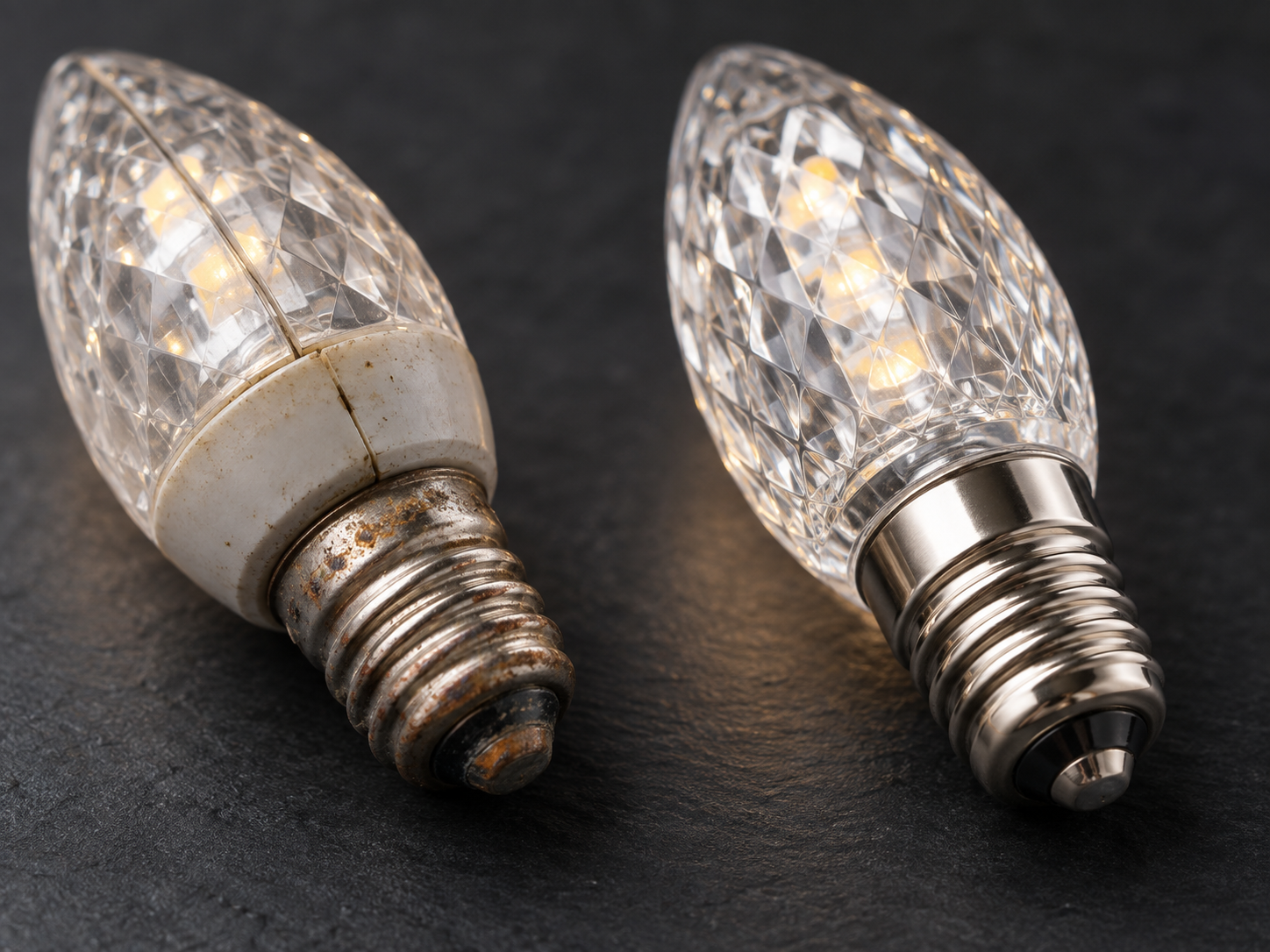
Cheap bulbs use a two-piece bulb and lens assembly. The seam is a moisture path. In a climate where December runs close to 90% relative humidity, water gets in, the bulb fogs or fails, and your display develops dead spots by mid-season.
One-piece bulb and lens construction removes that seam. Olympia Christmas Lights specs one-piece on every install for this reason alone.
Connections and bases
Corrosion at the socket is the single most common failure mode on Pacific Northwest displays. Pro-grade stringers use corrosion-resistant bases — nickel is common — and sealed connections. Retail sets use bare contacts that oxidize over one wet winter.
Add rubber socket seals on top of that. They're inexpensive, they keep water out of the connection, and in this climate they aren't optional hardware. Olympia Christmas Lights seals every socket on every install.
Wire
Look for 18 AWG and SPT-2 or SPT-2W jacketing. The W rating stays flexible in cold, which matters during January takedown when brittle insulation cracks at every bend and stress point. It's the spec Olympia Christmas Lights buys to, and the reason our sets come down intact.
How long do LED Christmas lights actually last?
Here's where the industry gets loose with numbers.
LED bulbs are commonly rated at 50,000 to 75,000 hours. A holiday season runs about 315 hours of actual operation — 7 hours a night for roughly 45 nights. Divide it out and you get a number in the hundreds of years, which should tell you the rating isn't the useful figure.
The diode is almost never what fails. What fails is the socket corroding, the wire insulation cracking after repeated freeze-thaw cycles, or physical damage during installation and removal. Those are the real limits, and they're set by build quality and handling, not by the LED itself.
So when you see "25-year lifespan" claims, treat them as a statement about component quality rather than a warranty. A well-built LED system handled carefully will outlast a retail set by many seasons. Olympia Christmas Lights won't put a specific year count on it, because the honest answer depends on how the lights are stored and handled between seasons — which is part of why we handle removal and storage ourselves.
Are LED Christmas lights safer?
Yes, and it's the least arguable point in the whole comparison.
LEDs run cool to the touch. Incandescent bulbs get hot enough to be a genuine ignition risk against dry material, and that risk compounds when a display runs seven hours a night for six weeks straight.
This is why Olympia Christmas Lights made the switch permanent rather than offering both. We won't hang a heat source on a customer's roof for six weeks.
Why pay more for professional-grade LEDs?
Because the up-front cost is higher and the per-season cost is lower.
Retail light sets typically last one to three seasons in this climate before enough of the run has failed that you're replacing it. Pro-grade sets, properly stored, last many seasons. Where the difference comes back:
No mid-season replacement runs
No hours spent diagnosing which bulb killed the section
Roughly $54 a season in electricity against incandescent
Lights that look the same on January 5th as they did the day they went up
If you're comparing a quote from Olympia Christmas Lights against a hardware store receipt, that receipt isn't the real comparison. The real comparison is the receipt plus your ladder time plus replacing it in two years.
Can you do different colors and bulb styles?
Yes. LED doesn't restrict your design options, which is a common misconception left over from the early years when LED holiday product came in one harsh blue-white.
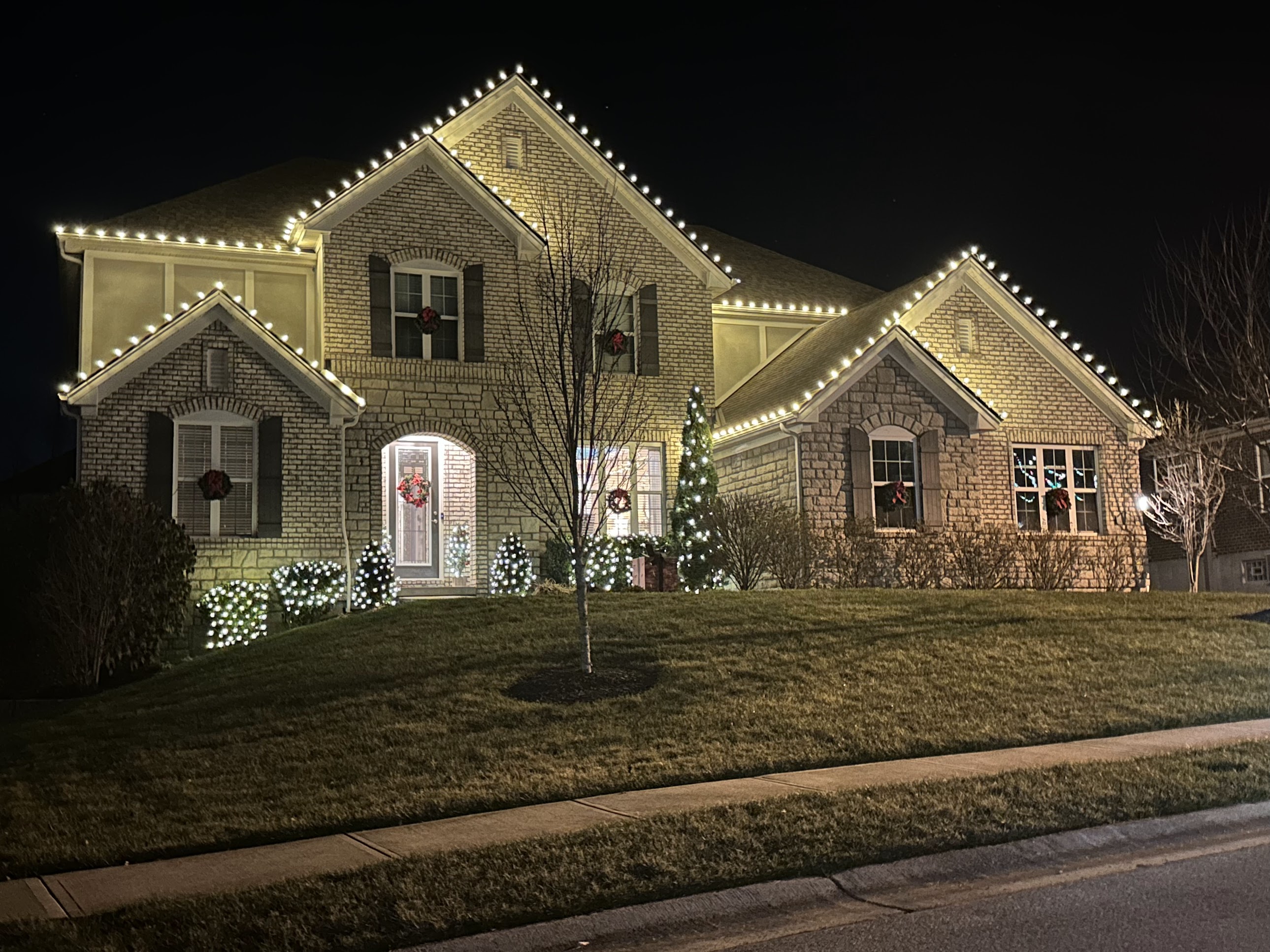
Current pro-grade LED covers warm white, cool white, and full multicolor across C7, C9, and M5 mini bulbs. Warm white is the default recommendation from Olympia Christmas Lights because it works with every exterior color and photographs well. Cool white holds contrast better against gray December skies, which is worth considering on a heavily overcast site.
You can get a roofline quote with any of these and we'll talk through which suits your home's siding and setback.
What Olympia Christmas Lights does with this
Every system we install is LED, one-piece construction, IP65 minimum with IP67 on gutter-line runs, corrosion-resistant bases, socket seals, and 18 AWG SPT-2W wire. Timers set and programmed to track sunset through the season. Removal and climate-controlled storage in January, so the components that actually determine lifespan get handled properly.
We don't install retail-grade product, and we won't quote incandescent. Those aren't restrictions on what you can have. They're the two decisions that keep a display looking right through a Thurston County December.
LED Christmas lights: quick answers
Why does Olympia Christmas Lights only install LED? Three reasons: the fire risk from hot bulbs running seven hours nightly for six weeks, the electrical ceiling that caps how large a display can be, and the operating cost. There's no scenario on an Olympia roofline where incandescent is the better engineering choice.
How much do LED Christmas lights save in Olympia? Roughly $54 across a season on a typical 200-foot C9 roofline — about $8 versus $62 at Washington's average rate near 14 cents per kWh. Smaller than national figures suggest, because Washington's power is cheap.
Can I run my whole display on one outlet? Usually yes with LED. A stringer maxes at 700 watts and a 15-amp circuit gives about 1,440 usable watts, supporting well over 1,000 feet of LED C9. Incandescent caps out near 200 feet.
What IP rating do Christmas lights need here? IP65 minimum for exposed runs, meaning dust-tight and protected against water jets from any direction. IP67 on gutter lines where water pools. Most retail "outdoor" sets are only IP44.
Does IP67 mean the lights are waterproof? No. It means temporary immersion, about 1 meter for 30 minutes. Enough for a backed-up gutter. Not a rating for permanent underwater use, and anyone describing it that way is overselling.
How long do professional LED lights last? The bulbs are rated 50,000 to 75,000 hours, effectively unlimited at 315 hours per season. Real lifespan comes down to socket corrosion, wire condition, and how the lights are handled and stored.
Are retail LED Christmas lights good enough? For a small covered porch, often yes. For an exposed roofline through an Olympia winter, usually not — two-piece bulbs let moisture in, sockets corrode, and IP44 isn't built for sustained exposure.
Are LED Christmas lights safe? Yes. They run cool, removing the ignition risk of hot bulbs sitting against dry material for six weeks.
What if something goes wrong during the season? Call (360) 915-2493 and we'll come out. Olympia Christmas Lights provides maintenance support through the season, and mid-season failures are uncommon with sealed commercial product.
How do I book, and what areas do you cover? Call (360) 915-2493 or request a quote for Christmas light installation in Olympia and Thurston County. We serve Olympia, Lacey, Tumwater, Yelm, Centralia, Chehalis, DuPont, Elma, and Shelton. Rooflines are measured off satellite imagery, so most estimates skip the site visit. Book in September or October for the best dates.