Christmas Roof Lights: Complete Guide for Olympia Homes
Your roofline is the highest, longest, most visible line on your house. It's also the hardest place to get lights right, because everything that makes a roof display look good or look sloppy happens at a height where the mistakes are obvious from the street and invisible from your ladder.
This guide covers what actually matters: which bulb to pick, how many you need, what your electrical circuit can handle, and which clips survive a Thurston County winter. It's the same decision process Olympia Christmas Lights walks through on every roofline we design across Thurston County.
Quick answer
For most Olympia homes, C9 LED bulbs on 12-inch spacing are the right call for a roofline. They're bright enough to read clearly from the street, they draw under a watt each so you can run the whole house on one circuit, and the larger bulb reads as professionally done rather than as string lights on a roof. C7 is the better choice on smaller homes, detailed trim, and rooflines that sit close to the sidewalk. Olympia Christmas Lights specs C9 on roughly three out of four homes we install.
Why rooflines matter more here than in most places
Olympia's December is genuinely dark. The shortest day of the year gives us about 8 hours and 30 minutes of daylight, and December averages roughly 2 hours of actual sunshine per day. From early December through January, most people leave for work in the dark and come home in the dark.
That cuts both ways. Your display runs during nearly every waking hour anyone might see it, which is more return on the same installation than a homeowner in Phoenix gets. But the flat gray overcast that comes with it also washes out weak lighting. A display that would look fine in clear dry air reads as dim and muddy through Pacific Northwest cloud cover.
This is the main reason Olympia Christmas Lights pushes brightness harder here than installers in drier climates do. In Olympia, under-lighting a roofline is a far more common mistake than over-lighting one.
The weather matters for hardware too. Olympia takes about 50 inches of precipitation across roughly 168 rainy days a year, and December is our most humid month at close to 89% relative humidity. Every socket on your roof spends the season wet. That's a materials problem, and it's why retail-grade lights that hold up fine in Denver fail here by mid-December. Every system Olympia Christmas Lights installs is commercial-grade for exactly this reason.
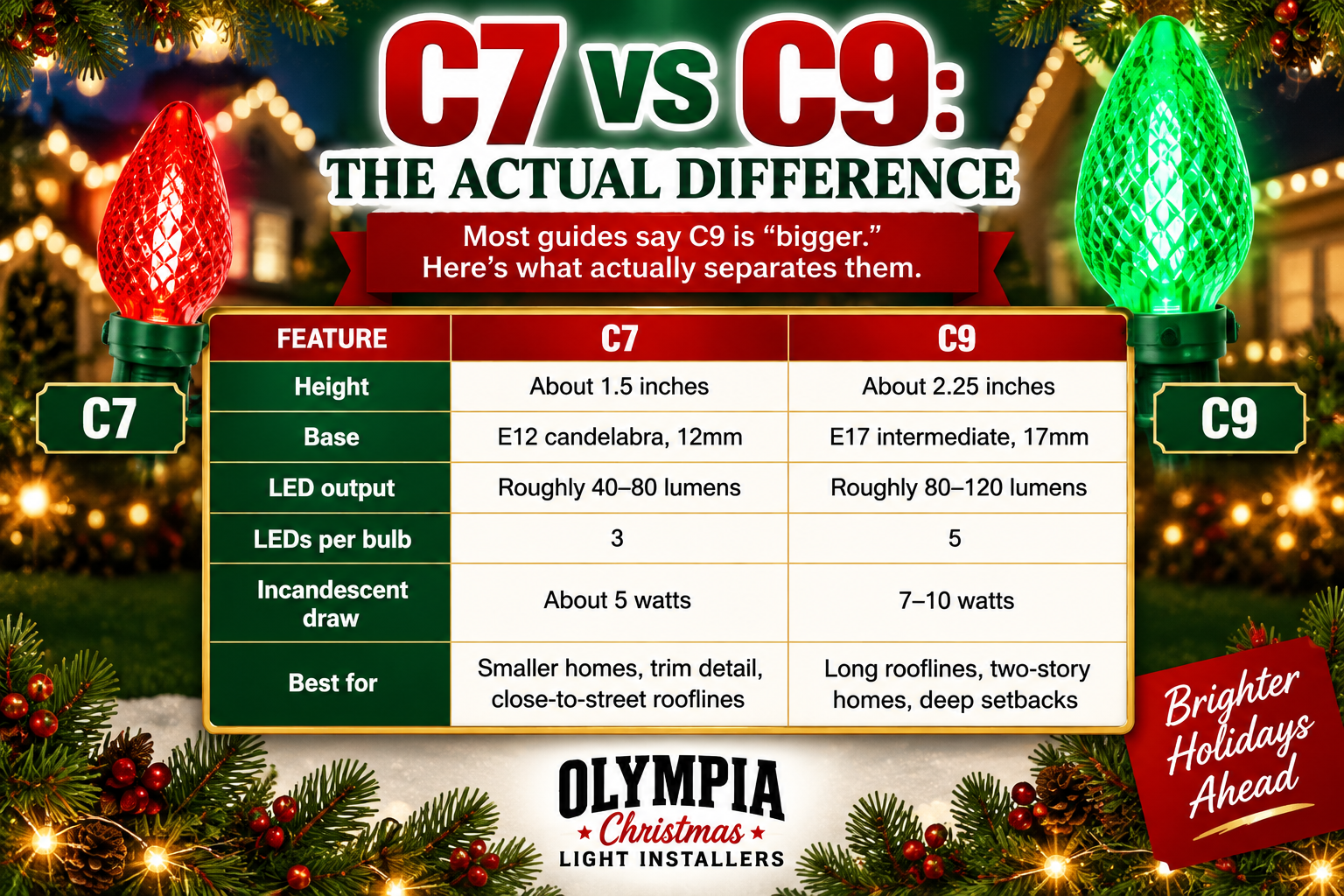
The bases are not interchangeable. A C9 bulb will not thread into a C7 socket and vice versa, which means the bulb decision and the stringer decision are the same decision. Getting it wrong means buying twice.
The night light test: if a standard night light bulb screws into your socket, you have C7 with an E12 base. If it's too small for the socket, you have C9 with an E17. Useful if you inherited lights with the house or lost track of what's in storage.
How to choose
Go C9 if your roofline runs more than about 80 feet, your house is two stories, you sit back more than 40 feet from the street, or you're on a corner lot where the display gets viewed from distance and from angles.
Go C7 if you're in a single-story rambler, your house sits close to the sidewalk, or your roofline has a lot of short runs, dormers, and direction changes. On tight architecture, C9 bulbs sit close enough together that they visually merge into a solid bar of light, and you lose the bulb-by-bulb definition that makes the look work.
If you're genuinely torn, go C9. It's the call Olympia Christmas Lights makes on most borderline homes. "Slightly too bright" is a much more forgiving failure than "you can't really see it from the road."
How many bulbs you actually need
Most C7 and C9 stringers use 12-inch socket spacing, which works out to one bulb per linear foot. So the math is simple: measure your roofline in feet, and that's your bulb count.
Measure every run you plan to light, including the returns on dormers and garage projections. Then add 10%. Corners eat more wire than the tape measure suggests, and you want spares, because a bulb that fails in the third week of December needs to be replaceable from a box in your garage rather than a special order.
A typical Olympia single-story ranch runs 90 to 140 feet of primary roofline. A two-story with an attached garage and a couple of gables usually lands between 160 and 260. Olympia Christmas Lights measures rooflines off satellite imagery before quoting, which is how we give same-day estimates without an on-site visit.
Decide one thing before you buy: whether you're lighting just the front-facing runs or wrapping the sides. Front-only is cheaper and captures most of the visual impact from the street. Wrapping the sides matters mainly on corner lots and homes with long side exposure to a neighboring street.
What your circuit can handle
This is the section most guides skip, and it's the one that causes actual problems.
A single stringer is rated for a maximum of 700 watts, and you shouldn't run more than 250 feet of 18-gauge wire regardless of how many sockets are on it. Past that you get voltage drop, and the far end of the run goes visibly dimmer than the near end.
Now run the numbers on a standard 15-amp household circuit, which gives you roughly 1,440 watts of usable continuous load:
Incandescent C9 at 7 watts each: about 200 bulbs, or roughly 200 feet of roofline. One circuit, one average house, and you're at the limit. Add landscape lighting or an inflatable and you're tripping breakers.
LED C9 at under 1 watt each: well over 1,000 feet. You'll run out of house long before you run out of circuit.
That gap is the real argument for LED, and it's a bigger deal than the electricity savings people usually lead with. LEDs use about 90% less energy than incandescent equivalents, which is nice on the December bill. But the practical benefit is that LED removes the electrical ceiling from your design entirely. You stop asking "can I power this?" and start asking "do I want this?"
It also means one outdoor GFCI outlet and one timer can run the whole display, instead of extension cords snaking to three sides of the house. This is why Olympia Christmas Lights installs LED exclusively and won't quote an incandescent system.
Icicle lights
Icicles hang from the gutter line in varying drop lengths. They read softer and more decorative than C7 or C9, and they're the right choice when you want the roofline to glow rather than to draw a hard bright line.
Two things determine whether icicles look good or look cheap.
Drop consistency. Quality icicle sets use a repeating, deliberate pattern of drop lengths. Cheap sets vary randomly, and from the street that reads as tangled rather than designed.
Wire color. Against a white gutter, white wire disappears. Against dark fascia, green or brown wire disappears. Getting this wrong is the most common reason a display's daytime appearance falls apart, and nobody thinks about it until the lights are up and they're looking at the house in daylight in January.
Icicles layer well with C9: C9 along the peak and structural lines, icicles on the gutter edge below. It's one of the most requested combinations Olympia Christmas Lights installs. You get distance visibility from the C9 and close-up texture from the icicles.
Cascade tubes and falling icicles
These are motion effects. Falling icicle and cascade tube bulbs fit standard E12 or E17 socket strings depending on the individual bulb base, so they drop into a C7 or C9 system you already own.
Used well, they're excellent as accents: a few on the peak, the porch columns, or one prominent gable. Used across an entire roofline, the effect stops reading as elegant snowfall and starts reading as a commercial display. Accent placement, not full coverage. Olympia Christmas Lights will talk you out of running them edge to edge.
Color
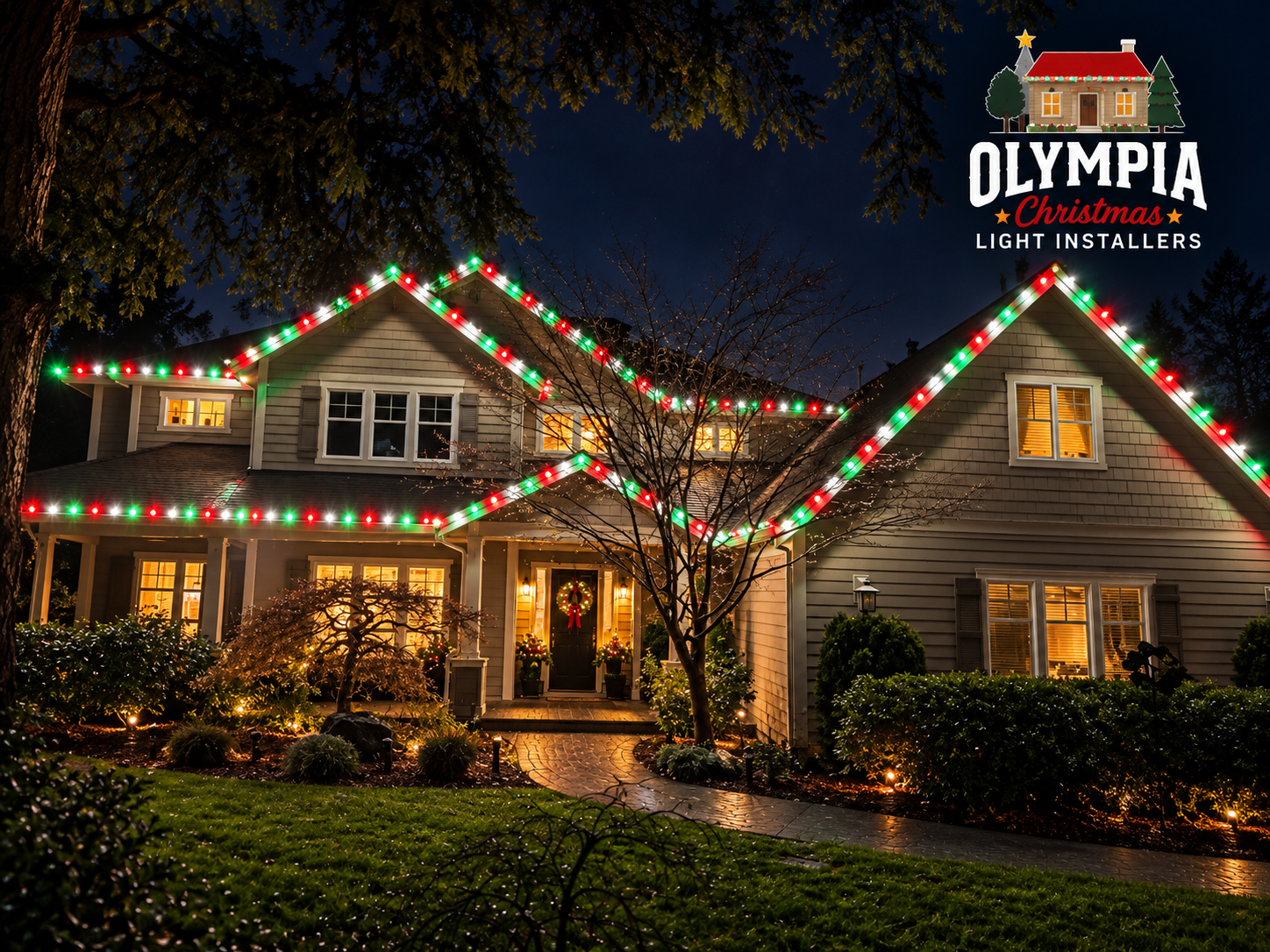
Most of what gets written about holiday light color is preference dressed up as advice. Two things about color are actually true in Olympia specifically.
Warm white is the safe default. It works with every exterior color and every architectural style, and it photographs well. If you're commissioning a display for the first time and you're unsure, warm white is the choice you're least likely to regret, and it's what Olympia Christmas Lights recommends by default.
Cool white and blue punch through overcast better than warm tones do. In flat gray December light, cooler colors hold their contrast against the sky. Warm white is prettier on a clear night. Cool white is more visible on the 18-plus rainy days December typically delivers.
Scheme | Reads as | Works best on |
|---|---|---|
Warm white | Classic, timeless | Any exterior; the default |
Cool white | Crisp, modern | Gray, blue, and white siding |
Red + green | Traditional Christmas | Brick, tan, neutral siding |
Red + white | Candy cane, playful | White or light siding |
Blue + white | Winter, cool | Gray and blue-toned exteriors |
All amber/gold | Warm, upscale | Brown, stone, wood-toned homes |
Multicolor | Festive, nostalgic | Families with kids; high-energy displays |
One practical rule: pick your roofline color first, then build everything else to match it. The roof is the largest lighting element on the property. Choosing pathway and tree lighting first and then making the roof agree with it is backwards, and it's how displays end up looking assembled rather than designed.
Clips: the part that decides whether it holds
Clip selection is where most DIY roof displays fail here, and the failure isn't small. Lights that sag in November look bad for six weeks. Lights that come loose in a December windstorm come down entirely.
The clip has to match the edge you're attaching to.
Shingle tabs slide under the shingle edge. Right for asphalt roofs where you're lighting the roof edge itself.
Gutter clips hook over the gutter lip. Right when you're lighting the gutter line rather than the shingle line.
All-in-one clips do both, which makes them convenient but slightly less secure in each individual application.
Ridge clips handle peaks and hips where there's no gutter and no shingle edge to grab.
Parapet and brick clips for masonry.
Never staple, nail, or screw lights into fascia or shingles. You're putting fastener holes in your building envelope, at the exact line where water runs off, in a climate that delivers 50 inches of rain a year. The damage shows up as rot two or three seasons later, long after anyone connects it back to the lights.
Two Olympia-specific notes. Use socket seals on C7 and C9 runs. Rubber socket seals keep moisture out of the connections and meaningfully extend bulb life, and in a climate sitting near 89% humidity through December that's not optional hardware. And increase clip density on exposed runs. Standard spacing is fine on protected elevations, but long runs facing open ground or water should be clipped tighter than the package recommends. Olympia Christmas Lights clips exposed elevations tighter than spec as standard practice, because a callback in a December windstorm costs everyone more than the extra clips do.
Timers
Set a timer, for two reasons beyond the obvious.
Sunset in Olympia moves by more than an hour between early November and late December, so a fixed on-time that's right on December 20th has your lights coming on in broad daylight in November. Photocell and astronomic timers track sunset automatically and solve this. Olympia Christmas Lights sets timers on every install and programs them to track sunset through the season.
Second, a display that runs 4:30pm to 11:00pm looks intentional. A display that's on at 3am looks forgotten. Small thing, but it separates a display that reads as maintained from one that reads as abandoned.
What Pacific Northwest weather does to lights
Retail-grade holiday lights are built for a season of use in average conditions. Ours are not average. Between sustained moisture, temperature swings around freezing, and wind off the water, this region is legitimately hard on outdoor lighting.
What fails, in order of frequency: socket corrosion from sustained moisture, wire insulation cracking at stress points after repeated freeze-thaw cycles, and clip failure on exposed runs during storms.
Commercial-grade systems address this with heavier gauge wire, sealed sockets, and UV-stable materials, which is the standard Olympia Christmas Lights builds to. It's the biggest quality difference between a display that looks the same in January as it did in November and one that's visibly degraded by Christmas.
Should you do it yourself?
Honest answer: it depends almost entirely on your roof, not on your skill.
DIY is reasonable on a single-story home with a walkable pitch, a straightforward roofline, and safe ladder footing on level ground. The work is tedious but not technical.
Hire it out, whether that's professional Christmas light installation in Olympia from us or another licensed and insured crew, if you have a two-story, a steep pitch, a wet moss-prone roof, or ladder setup on a slope. Roof work in a Pacific Northwest fall means working on wet surfaces in low light. Emergency room visits for holiday decorating injuries spike every December, and ladder falls lead the list.
There's also takedown, which people consistently underestimate. Installation happens in mild dry November weather when you're motivated. Removal happens in January when it's 38 degrees and raining and the novelty is long gone. Whatever you decide, decide it for both ends of the season. Olympia Christmas Lights handles removal and off-season storage as part of every install, so the January problem never becomes your problem.
What's the difference between C7 and C9 bulbs? C7 bulbs are about 1.5 inches tall with an E12 candelabra base. C9 bulbs are about 2.25 inches tall with an E17 intermediate base. C9 is brighter and better for long rooflines and two-story homes. C7 suits smaller homes and detailed trim. The bases don't interchange, so decide before you buy stringers. Olympia Christmas Lights installs both and will spec the right one for your roofline.
How many Christmas lights do I need for my roofline? Standard C7 and C9 stringers use 12-inch spacing, so one bulb per linear foot. Measure your roofline and add 10% for corners and spares. A typical single-story Olympia home needs 90 to 140 feet. A two-story with a garage usually runs 160 to 260. Olympia Christmas Lights measures this for you as part of the free quote.
Can I run my whole display on one outlet? With LED, almost certainly. A stringer maxes out at 700 watts and 250 feet of 18-gauge wire. With LED C9 under a watt per bulb, a standard 15-amp circuit handles well over 1,000 feet. With incandescent C9 at 7 watts, you're capped around 200 feet.
Are LED Christmas lights worth it? Yes, for three reasons that aren't the obvious one. They use about 90% less energy, they stay cool to the touch, and they remove the electrical ceiling on display size. The energy savings are real but modest. The design freedom is the actual benefit.
Will roof clips damage my roof? Properly selected clips won't. They grip the shingle edge or gutter lip without penetrating either. Staples, nails, and screws absolutely will, and in a climate this wet the water intrusion shows up as rot two or three seasons later.
When should I book professional installation in Olympia? September or October. Olympia Christmas Lights fills its calendar roughly in booking order, and the prime slots in mid-to-late November before Thanksgiving go first. Booking in December usually means taking whatever date is left.
Can I leave the lights up year-round? Standard holiday lights, no. UV degrades the wire insulation and clips weren't designed for a twelve-month load cycle. If you want year-round capability, permanent LED track lighting is a different product built for exactly that, with color changing for other holidays. Ask Olympia Christmas Lights about permanent lighting if that's the direction you're leaning.
How long do professional-grade LED bulbs last? Commercial LED bulbs are typically rated in the tens of thousands of hours. A holiday season runs roughly 400 to 500 hours of actual operation, so the practical limit is usually physical damage or socket corrosion rather than the diode wearing out. Which is exactly why socket seals matter here.
Get a roofline quote
Olympia Christmas Lights designs, installs, maintains, and removes holiday lighting across Olympia, Lacey, Tumwater, Yelm, Centralia, Chehalis, DuPont, Elma, and Shelton. Commercial-grade C9 and C7 systems, professional clips, timers set, cords hidden, storage handled in the off-season.
Call (360) 915-2493 or reach the Professional Christmas Light Installers - Olympia Christmas Light Installers team for a same-day estimate. We measure rooflines off satellite imagery, so most quotes don't require an on-site visit.