Drab to Fab: What Makes a Christmas Light Display Look Professionally Designed
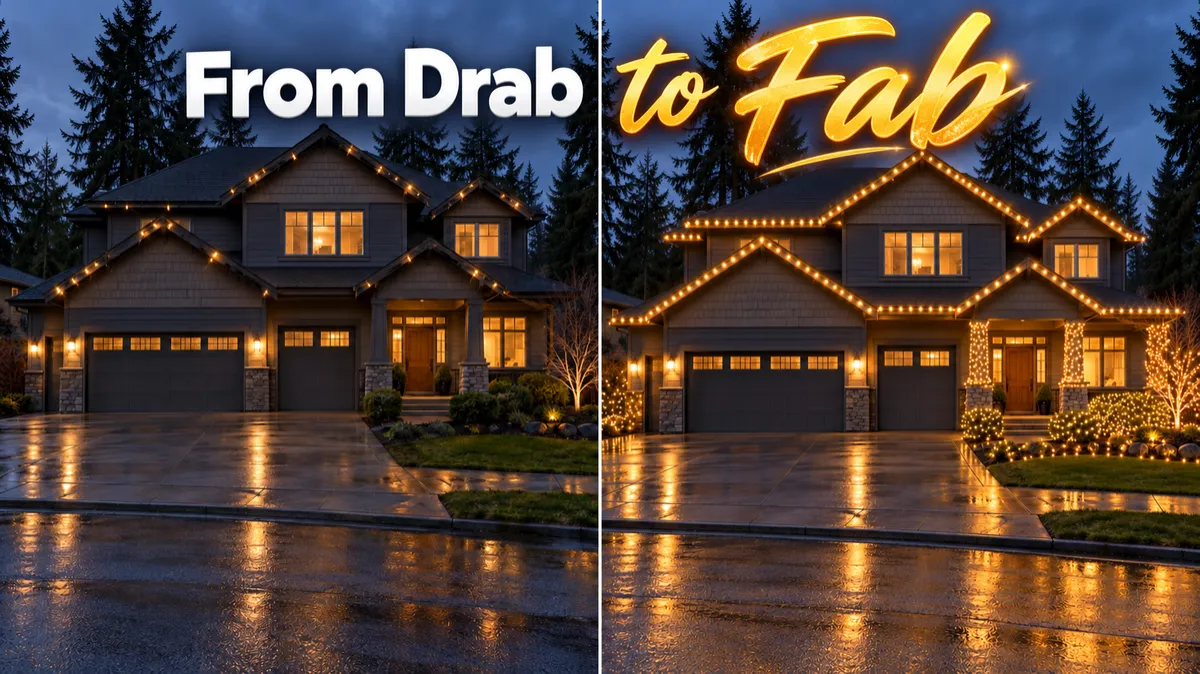
Drive through South Capitol or West Olympia in mid-December and you'll pass two houses with roughly the same lights on them, where one looks finished and the other looks like someone ran out of string halfway through.
Same bulbs. Same color. Completely different result.
The difference almost never comes down to how much was spent. It comes down to six decisions, and most of them get made before a single clip goes on the roof. Olympia Christmas Lights makes these calls on every home we design, and they're the same ones you'd make yourself if you knew which ones mattered.
Quick answer
A display reads as professionally designed when the lines are continuous, the spacing is even, the color story is limited to one or two choices, and the display stops at a deliberate edge rather than trailing off. Everything else — bulb count, budget, how many elements you light — matters far less than people assume.
Why does one house look designed and the next looks decorated?
Because the eye reads structure before it reads brightness.
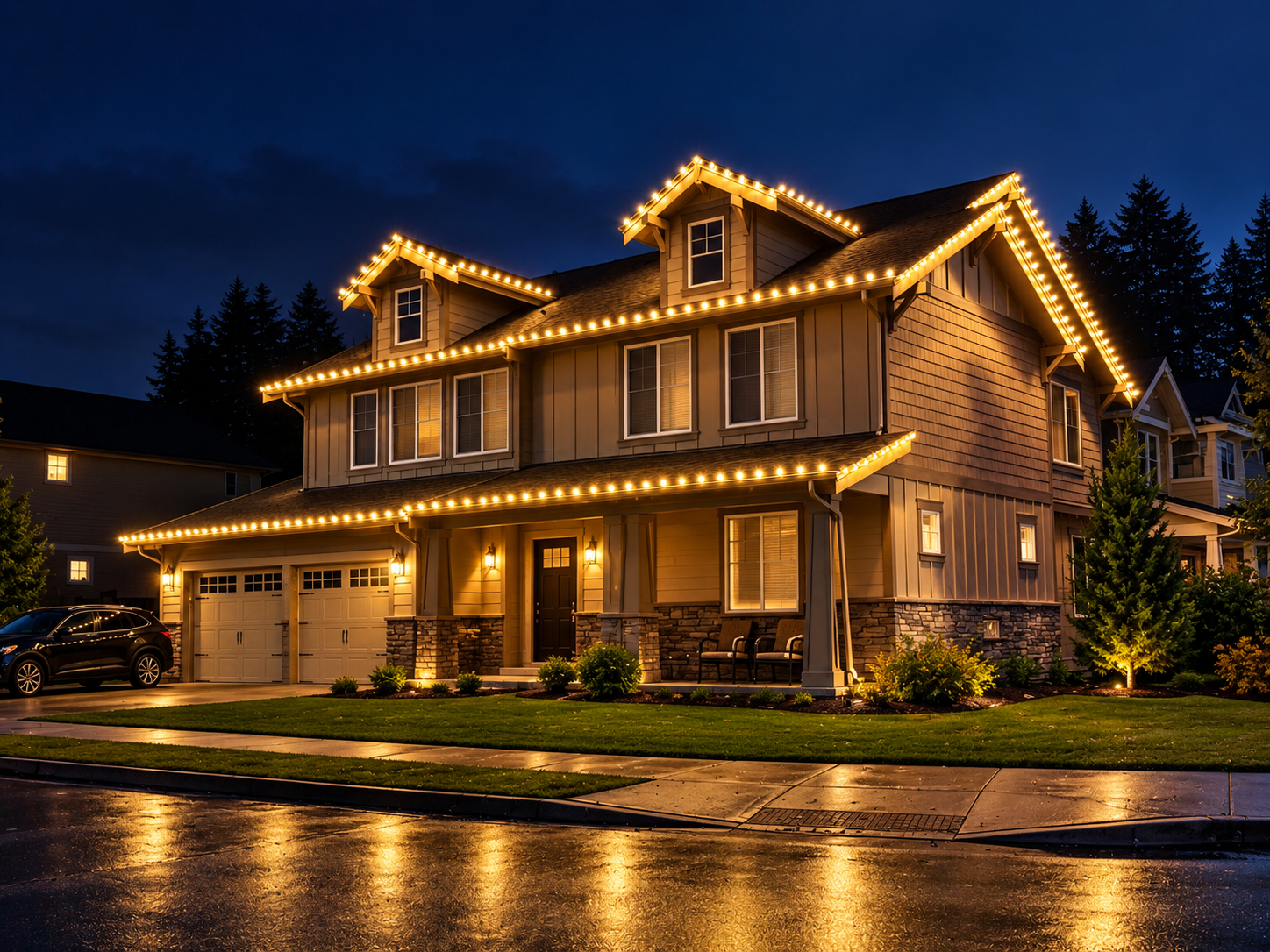
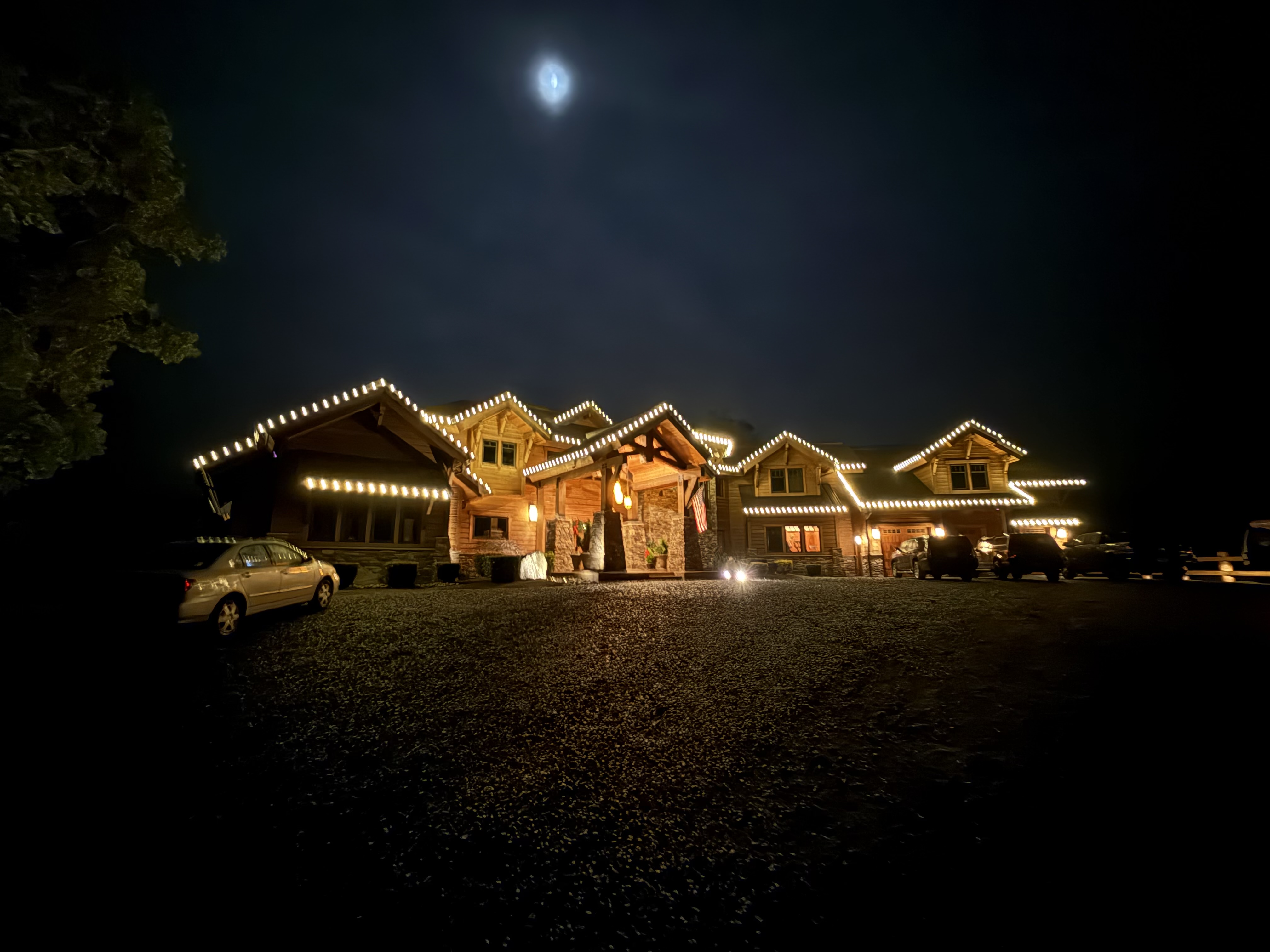
A roofline outlined in one unbroken line of evenly spaced bulbs registers as intentional, even at low brightness from across the street. A roofline with three gaps, two different bulb spacings, and a section that stops short of the corner registers as unfinished, no matter how bright it is.
This is why adding more lights rarely fixes a display that looks wrong. The problem isn't quantity. It's that the structure underneath is broken, and more lights on a broken structure just make the breaks more visible.
Olympia Christmas Lights starts every design with the lines, not the lights.
Rule 1: Follow the architecture, don't fight it
Your house already has lines. The roofline, the gable peaks, the porch columns, the window frames, the fascia above the garage. A professional display traces those lines. An amateur display adds new ones.
This matters more in Olympia than in a lot of places because of how varied the housing stock is. South Capitol has older homes with deep porches, detailed trim, and complex rooflines full of short runs and direction changes. Newer subdivisions out toward West Olympia and Lacey have longer, simpler rooflines with fewer features to work with.
Those two houses need opposite approaches. On the older home, the architecture is doing the work and the lights should follow it closely and restrainedly. On the simpler roofline, there's less to trace, so the display needs a deliberate focal point — a lit gable, a wrapped column, a tree — or it reads as a plain bright line and nothing else.
The most common DIY mistake Olympia Christmas Lights gets called to fix is lights strung in a shape the house doesn't have: a swag across a flat fascia, a zigzag where the roof runs straight. It fights the building, and the eye catches it immediately.
Rule 2: Unbroken lines, consistent spacing
This is the single biggest visual tell, and it's almost entirely a materials and measurement problem rather than a skill problem.
Retail light sets come in fixed lengths. Your roofline doesn't. So a homeowner working with 25-foot sets either comes up short and leaves a gap, or overlaps and ends up with a bunched section where the spacing doubles. Either one is visible from the street.
Professional installs use bulk stringer wire cut to the exact length of each run, with sockets at consistent 12-inch spacing — one bulb per linear foot. Every run starts at a corner and ends at a corner. No gaps, no bunching, no doubled-back sections tucked behind a downspout.
Measure your rooflines before you buy anything. Add 10% for corners and spares. The arithmetic takes fifteen minutes and prevents the single most common reason a display looks amateur.
Rule 3: Commit to one color story
Pick one scheme and hold it across the entire property. Warm white everywhere. Or red and white everywhere. Or multicolor everywhere.
The display that looks chaotic is almost always the one where the roof is warm white, the bushes are multicolor, the porch is cool white, and there's a blue inflatable on the lawn. Each piece might look fine alone. Together they read as four unrelated decisions.
For Olympia specifically, warm white is the safest default — it works with every siding color and photographs well. Cool white holds contrast better against our gray December skies, which is worth considering on a heavily overcast site. Olympia Christmas Lights recommends warm white on most homes and cool white on contemporary exteriors with gray or blue siding.
If you want color, use it as an accent against a dominant neutral rather than mixing several colors at equal weight. One dominant color plus one accent reads as designed. Four colors at equal weight reads as whatever was on sale.
Rule 4: Build in layers, at different heights
A display with lights only on the roofline looks flat. The eye takes it in at one glance and moves on.
Layering gives the display depth. The standard structure is three levels:
Layer | What it does | Typical elements |
|---|---|---|
High | Defines the shape of the house | Roofline, gable peaks, dormers |
Mid | Fills the gap between roof and ground | Columns, window frames, door surround, wreaths |
Low | Grounds the display, adds depth | Shrubs, pathway stakes, wrapped tree trunks |
Most DIY displays do the high layer and stop. Adding even a modest mid and low layer — a wrapped porch column and two lit shrubs — does more for the finished look than doubling the bulb count on the roof.
This matters in Olympia because of the evergreens. Tall firs and cedars crowd a lot of properties here, and they'll swallow a roof-only display from certain angles. Lower layers stay visible when the high layer is partly screened by a tree line.
Rule 5: Give the eye somewhere to land
Every good display has one thing that's clearly the main event. A lit front gable, a wrapped specimen tree, an illuminated entry.
Without a focal point, a display is just evenly distributed brightness, and there's nowhere for the eye to rest. With one, everything else reads as supporting it, and the whole thing hangs together.
Pick the feature your house already leads with. If there's a prominent gable facing the street, that's it. If there's a mature tree in the front yard, that's it. Olympia Christmas Lights picks the focal point during the design walk, before deciding anything else, because every other choice follows from it.
Rule 6: Stop at a deliberate edge
Displays that trail off look unfinished. Lights that run along the front roofline and then just stop partway down the side of the house, or a pathway of stakes that ends in the middle of the walk, tell the viewer you ran out of material.
Decide where the display ends and make that edge intentional — a corner, a property line, the end of a run. Stopping short of the corner reads as a mistake. Stopping at the corner reads as a choice.
This is where professional Christmas light installation in Olympia earns a lot of its value. Not in doing anything you couldn't, but in having enough material on the truck to finish the run properly instead of improvising at 4pm when the light is going.
What this looks like in the Pacific Northwest specifically
Three things about our climate change the design math here.
It's dark for most of the viewing day. Olympia's shortest day gives about eight and a half hours of daylight, and December averages roughly two hours of actual sunshine. Your display runs during nearly every waking hour anyone might see it, which is more return on the same work than almost anywhere else in the country.
Overcast flattens weak lighting. Gray cloud cover washes out displays that would look fine in clear dry air. In Olympia, under-lighting is a much more common error than over-lighting, which is the opposite of the advice you'll read on most national sites.
Everything is wet. We take about 50 inches of rain across roughly 168 rainy days a year, with December humidity near 90%. Every socket spends the season damp. A design that looks perfect in November and has three dead sections by Christmas isn't a design problem, it's a materials problem — and it undoes all six rules above. Olympia Christmas Lights installs commercial-grade sealed systems for exactly this reason.
Can you do this yourself?
Mostly, yes — and it's worth saying plainly.
The six rules above are design decisions, not trade secrets. On a single-story home with a walkable pitch and level ladder footing, a careful homeowner who measures first, buys bulk stringer instead of fixed-length sets, and commits to one color will get a result that looks genuinely good.
Where it stops being reasonable is height and pitch. Two stories, a steep roof, a wet moss-covered surface, or ladder setup on a slope — that's real fall risk, in low light, on wet footing, and ER visits for holiday decorating injuries spike every December with ladder falls leading the list.
And there's takedown, which people underestimate every single year. You hang lights in mild November weather when you're motivated. You take them down in January when it's 38 degrees and raining. Whatever you decide, decide it for both ends.
Olympia Christmas Lights handles removal and off-season storage as part of every install, which is also what keeps the system working for years instead of seasons.
Getting a design done
Olympia Christmas Lights designs, installs, maintains, removes, and stores holiday lighting across Olympia, Lacey, Tumwater, Yelm, Centralia, Chehalis, DuPont, Elma, and Shelton. Commercial-grade C9 and C7 systems, bulk stringer cut to your exact rooflines, professional clips, timers programmed to track sunset.
You can get a roofline quote without a site visit — we measure off satellite imagery and most estimates come back same day.
What makes a Christmas light display look professional? Continuous unbroken lines, consistent bulb spacing, one or two colors rather than four, lighting at multiple heights, a clear focal point, and a deliberate stopping edge. Structure matters far more than bulb count or budget.
Why does my display look messy even though I used a lot of lights? Almost always a structure problem, not a quantity problem. Gaps in the runs, inconsistent spacing where fixed-length sets overlapped, or too many competing colors. Adding more lights to a broken structure makes the breaks more visible, not less.
How many colors should a Christmas light display use? One dominant color, with at most one accent. Warm white everywhere reads as designed. Warm white roof, multicolor bushes, and cool white porch reads as three unrelated decisions made separately.
What's the most common DIY Christmas light mistake? Buying fixed-length retail sets instead of measuring first. Your roofline isn't a multiple of 25 feet, so you end up with a gap or a bunched overlap, and both are visible from the street.
Should I light more than just the roofline? Yes. A roof-only display looks flat. Adding a mid layer (columns, windows, entry) and a low layer (shrubs, pathway, tree trunks) gives depth. It matters especially in Olympia, where tall evergreens screen roof-only displays from some angles.
What color Christmas lights work best in Olympia? Warm white is the safest default and suits any siding color. Cool white holds contrast better against heavy December overcast and suits contemporary gray or blue exteriors.
Why do professional displays look brighter? Partly commercial-grade bulbs, but mostly because pros over-light for the climate. Pacific Northwest cloud cover flattens a display that would look bright in dry air, so under-lighting is the more common mistake here.
Can I get a professional look doing it myself? On a single-story home with safe ladder footing, yes. Measure first, buy bulk stringer wire instead of fixed-length sets, and commit to one color. The six design rules aren't trade secrets. Height, pitch, and wet roofs are where it stops being worth the risk.
When should I book professional installation in Olympia? September or October. Calendars fill roughly in booking order and the mid-to-late November slots before Thanksgiving go first. Booking in December usually means taking whatever is left.
Do you serve areas outside Olympia? Olympia Christmas Lights covers Olympia, Lacey, Tumwater, Yelm, Centralia, Chehalis, DuPont, Elma, and Shelton. Call (360) 915-2493 or request a Christmas light design quote for Thurston County to check your address.